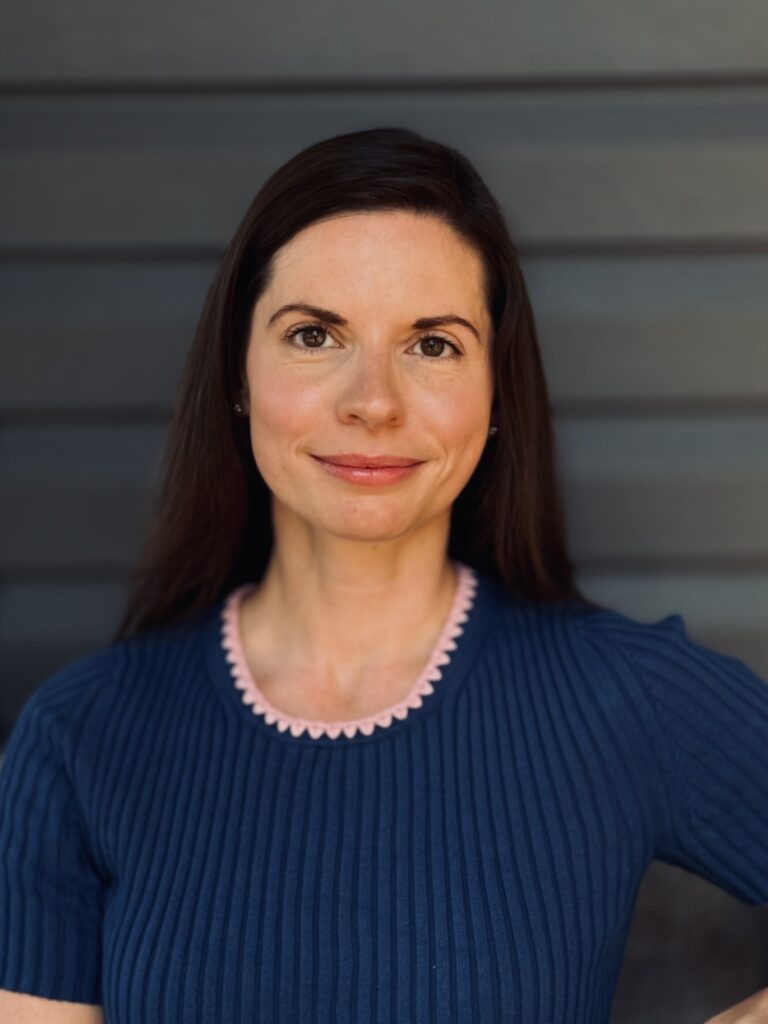
Katie Shay Perault is the Principal of Open Water Strategies, an independent consulting practice focused on responsible business with a specialization in AI governance, human rights, and leadership development. She partners with companies to navigate complex regulatory environments, align with global standards, and turn responsible business commitments into meaningful, long-term impact.
shgshfh
hsgfatr
Check Below for a Q&A with Katie Shay Perault!
Before establishing her practice at Open Water Strategies, Katie designed and led human rights and AI governance programs inside global technology companies. At Cisco Systems, Inc., she founded both the Business and Human Rights Program and the Responsible AI Program, creating governance frameworks that continue to guide the ethical development and deployment of emerging technologies. Earlier in her career, she served as Business and Human Rights Counsel at Yahoo, where she addressed global issues of privacy and freedom of expression, and as Legal & Policy Coordinator at the International Corporate Accountability Roundtable, where she advanced corporate accountability policies and practices.
In addition to her work with CASE, Katie is a member of the International Foundation for Electoral Systems’ AI and Elections Advisory Group (AI AGE) and is recognized as a trusted expert and sought-after speaker on responsible business and technology governance. She has shared her expertise at major forums including the United Nations, RightsCon, and the National Academies of Sciences, Engineering, and Medicine (NASEM).
Katie holds a J.D. from Georgetown University Law Center and a B.A. in English Literature from Marquette University. She lives in Durham, North Carolina, with her husband and two young children.
Senior Fellow Q&A
To start, can you introduce yourself and share a bit about your professional background that brought you to this CASE Senior Fellow role?
For the past decade, I’ve worked inside major technology firms, advising executives on responsible business strategy and implementation. My training as a human rights lawyer shapes how I approach new challenges: I assess both benefits and risks to people, engage stakeholders across functions and geographies, and translate insights into practical guidance that leaders can act on. When I was at Cisco, I founded the Business and Human Rights and Responsible AI programs, both of which went beyond high-level principles to establish robust governance frameworks that guided decisions on market entry, product features, incidents, and stakeholder expectations.
Most recently, I launched my own consulting firm to work with a broader set of companies seeking to put their principles into action. I help organizations build the internal capabilities to make these decisions consistently and confidently, not just in response to a crisis. What sets me apart is hands-on experience advising organizations navigating challenging product timelines, complex geopolitical environments, and emerging regulations.
From your perspective, what are some of the most important trends or shifts happening now that our audience should be aware of?
I’m particularly attuned to the evolving regulatory landscape for AI governance. Right now, the EU AI Act is setting the global standard for what companies will need to do to meet regulatory expectations, and other governments are likely to follow. While some argue that regulation could slow innovation, companies that build thoughtful governance frameworks are better positioned to manage risk, maintain trust, and compete globally.
Beyond regulatory pressure, public expectations are shifting rapidly. Customers want to understand the social impact of the technologies they use, employees seek purpose-driven work, and investors are increasingly evaluating ESG factors. These trends are transforming responsible AI from a compliance requirement into a strategic advantage and a differentiator in the market.
Looking ahead, what do you think organizations, companies, or leaders need to be paying attention to in order to create meaningful impact in the coming years?
The same frameworks that help major businesses address human rights and AI risks are equally valuable for social ventures, nonprofits, and mission-driven organizations. Good intentions alone aren’t enough.
I’ve seen well-meaning organizations unintentionally exclude people because they didn’t evaluate the real-world effects of their decisions, assuming that because they were mission-driven, their impact would be positive.
Applying responsible business frameworks consistently and digging in to understand potential impacts at all phases of the product lifecycle helps organizations anticipate unintended consequences and maximize positive impact. This approach will be especially important for ventures that want to address major societal challenges, from the future of work and democratic governance to privacy and data protection in a world where tracking technologies are becoming ubiquitous.
Based on your experiences, what advice would you give to students who want to pursue a path in social impact and innovation?
Lead with curiosity, because the most pressing social challenges rarely have straightforward solutions. Ask questions, explore problems from multiple angles, and don’t be afraid to dive into areas where you feel uncertain. Real progress comes from listening carefully to others (especially when you disagree), understanding their motivations, and finding ways to collaborate.
Finally, don’t worry about following a linear career path. Some of the most meaningful experiences come from unexpected detours, projects outside your field, or roles that force you to stretch. This was certainly true for me when I made the leap from civil society to the tech industry. Each new experience is an opportunity to build perspective, resilience, and skills you can translate into meaningful impact.
What excites you most about partnering with our community in this Senior Fellow role, and what are you hoping to contribute or share during your time here?
There are so many smart people at CASE, Fuqua, and the broader Duke community thinking about these issues from different angles, and I am excited to challenge my own thinking and expand my perspective.
And I hope to help students learn not just the principles, but also the practical tools, governance frameworks, and decision-making processes that translate responsible business principles into operational practice. CASE’s commitment to developing leaders who think critically about social impact and innovation aligns perfectly with my professional goal of advancing the field of responsible business in practice.